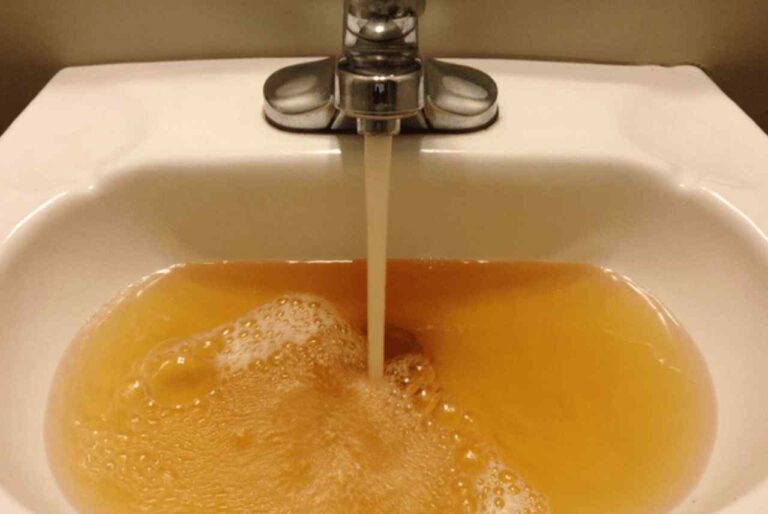
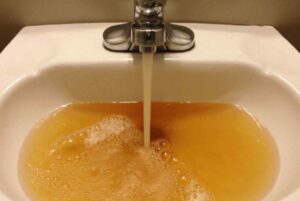
Just imagine, you’re home after a long exhausting walk, and you headed to the basin to refresh yourself. But you notice with utter disappointment that the water released by your faucet is not transparent as usual, rather a bit cloudy. Gradually it became brown That’s why your question – Why is the water in my faucets brown and cloudy.
If you’re not super-lucky throughout your life, you’ve experienced this situation more than once in your day to day life. But have you ever wondered why?
Here, in this guide, we’ll show you why and how this happens, what to do about it, and so on. Let’s begin!
Why Does It Happen?
Rust and Pipe Ingredients
A rusty galvanized pipe is more likely to be the culprit. If you are using a very aged water supply system or an inactive water heater, it is more likely to have rust growing in both the pipes and faucets.
When the water passes through the pipes, the rust makes your water brown and cloudy. In most cases, if cast iron and lead pipes degenerate over time, rust and other pipe ingredients pipe peel off into the water.
Iron itself produces an orange or brownish color, while lead mostly makes the water cloudy and includes microscopic particles.
Furthermore, rubber plumbing materials, like gaskets or O-rings, can split down into apparent black particles in your water.
Change of Water Source Or New Water Source
A new water source is another frequent reason for water discoloration. A change in your water source can also be connected to the discoloration of water.
When a new water source (for example a river or reservoir) is connected to the supply system, the muds align with organic and inorganic small particle appears in water for sometimes.
But it is temporary, very soon, the dirt will get cleared out, and you will bring clean water as usual.
Seasonal Changes
It is reasonable that the problem with the color of your water is merely seasonal. In some regions, the water becomes brown and cloudy during fall because a water supply from a reservoir covers those regions.
In the fall, the saved water tends to discolor change color a bit. Moreover, Water pollution level also alters due to seasonal changes. This kind of discoloration has no immediate remedy until the water becomes normal itself.
Chemical Pollution
Rainwater washes away chemicals, for example, pesticides, fertilizers in agricultural communities, the industrial waste from different commercial factories, the residue of motor oil on highways, and so on.
These chemicals get absorbed, along with the water, into the surface water and eventually become groundwater that feeds your faucet.
Organic Substances
Various organic matters can make your water discolored. Dissolved organic substances, for instance, peat, humus, or decaying plant matter, may cause a yellow or brown color in your water.
Water Pressure
This one is not typical, but it’s feasible that your pipes extreme water pressure can make your water look cloudy. The water usually clears up after you keep the faucet open for 2 or 3 minutes.
However, sometimes there may be a problem in your supply system causing continuous water pressure. In this case, it will not be solved without expert observation.
Air
Your water may have a cloudy intransparent look if excessive air is trapped or passing through it.
How to Fix?
Examine Your Water
Polluted water can be fatal to health, but merely a discoloration does not necessarily indicate that your water is injurious to health. However, you must examine the water carefully to ensure whether it is really healthy.
Run a simple test. Take some water in a glass and until it’s stable and all the bubbles disappear. Now, observe the water carefully; if the water is just cloudy or unclear, it’s more likely harmless for you.
But if you see colored particles floating in it, this water is not recommended for drinking, bathing, or not even for laundry (stains may show up on your clothes due to this discolored water).
Check Your Neighbours
Ask your neighbors. See whether they are facing the same problem. If not, then it must be an issue about your pipeline or faucets.
If the problem is the same for your neighborhood, immediately file a complaint to your municipality or local water supply authority.
Check Every Single Faucet
To identify the defective area in your water system, one of the techniques is to isolate the faucets and check one at a time.
Assure whether it’s a problem with only one or more specific faucets. If yes, then your main water supply system is okay, and you need to fix the particular faucets and their directly corresponding pipes only.
If it’s the same for all the faucets, then there is an issue with your main supply system, and it is needed to be checked and repaired where necessary.
Call a Professional Plumber
If the problem lies only with your water, not with your neighbors’ ones, you must call a professional plumbing expert to fix the problem.
Try to contact a very experienced plumber because sometimes inexperienced plumbers may not fix the problem; instead, they make it worse.
Brief the plumber with specific information about your water supply system along with your problems.
Use a Purifier or Buy Jars
Use a purifier for drinking if you cannot instantly find an appointment for a plumber. Or you can also buy some purified water jars for your temporary use until the problem is fixed.
Faqs
What does it mean when faucet water is cloudy white or milky?
Cloudy or milky white water is almost always air bubbles — not contamination. Dissolved air gets trapped in water under pressure inside the pipes and releases when it hits your tap, giving it that hazy, white appearance. The easy test: fill a glass and let it sit still for a minute or two. If the cloudiness clears from the bottom up, it’s just air and it’s completely harmless. If it stays cloudy or turns another color, that’s when you need to investigate further.
Why is the water brown only from the hot tap and not the cold?
That’s almost certainly your water heater. When brown water comes from only the hot side, sediment and rust have built up inside the heater’s tank — especially if it’s older or hasn’t been flushed in years. It’s a very common problem. The fix is flushing and draining the water heater to clear out the sediment. If the heater is very old or the corrosion is severe, it may be time to replace it entirely rather than just flush it. A plumber can assess that quickly.
The water is brown in every faucet in the house — what does that mean?
When every single faucet is affected, the problem isn’t inside your house — it’s coming from the main water supply. This could be caused by a water main break nearby, maintenance work on the municipal supply lines, or seasonal changes affecting the reservoir feeding your area. Check with your neighbors first. If they’re seeing the same thing, call your water utility company and report it. They’ll usually tell you if there’s a known issue and how long it’s expected to last. Run your cold taps for a few minutes to help flush it through.
Can seasonal changes actually make tap water go brown?
Yes, and it catches a lot of people off guard. In areas supplied by reservoirs, fall is the most common time for water discoloration. As temperatures drop, the water in reservoirs undergoes a natural turnover — deeper, darker water mixes with surface water, causing temporary discoloration. Heavy rainfall also washes surface contaminants like agricultural runoff, pesticides, and organic matter into groundwater and reservoirs. There’s usually no quick fix for this type — you wait it out and use filtered water in the meantime.
Could high water pressure be making my water look cloudy?
Yes, it’s possible. Extreme water pressure forces more air into the water as it moves through pipes, which can give it a cloudy appearance at the tap. In most cases the water clears up on its own within 2 to 3 minutes of letting it run. But if it stays cloudy for longer or keeps happening, your supply system’s pressure may be consistently too high — that’s a problem worth having a plumber look at before it causes damage to your pipes and fixtures.
What organic matter causes brown or yellow water?
Naturally occurring organic substances in groundwater — things like peat, humus, and decaying plant matter — can give water a yellowish or brown tint. This is more common in rural areas or homes on well water where groundwater passes through soil rich in organic content. It’s not the same as rust discoloration and has a different quality to it — more of a tea-like tint rather than a reddish-brown. A water test will confirm exactly what’s in your water so you can choose the right filtration solution for it.
The brown water is only in one faucet — what's causing it?
If just one faucet is producing brown water while all others are fine, the problem is localized. Most likely culprits are a corroded pipe feeding just that fixture, a failing aerator trapping rust particles, or sediment buildup in that specific faucet’s valve. Start by removing and inspecting the aerator — if it’s full of rust-colored debris, clean or replace it. If the problem persists after that, the supply pipe to that fixture may need attention from a plumber.
When should I call a plumber for brown or cloudy water?
Call a plumber if: the brown water is only in your home (not your neighbors’), it’s been going on for more than a day or two without improving, it’s coming from just the hot side (water heater issue), or the water has any smell to it — metallic, sulfur, or earthy. Also call if you’re on well water and notice sudden discoloration, since that can indicate a well integrity problem that needs urgent attention. Use filtered or bottled water in the meantime and don’t delay — water quality issues left unaddressed tend to get worse, not better.
Final verdict
Water has always been the most valuable natural element in human life, although we don’t feel it. We recognize its importance only when we’re having a problem with its supply.
Therefore, never neglect any changes in your water so that you don’t run into a worse situation in the future. Always take care of your faucets and pipes, renovate when needed.
Use a water purifier for drinking water if you think your water supply is not healthy enough. And never compromise about healthy water. Live healthily!
People also search for
- Ultimate Kitchen Faucets Buying Guide | Complete Buying Guide
- How to Fix a Leaky Faucet with a Non-Removable Handle (All 4 Faucet Types — Step-by-Step)
- How To Unclog A Garbage Disposal Clogged With Potato Peels?
- How to Repair Low Pressure in A Kitchen Faucet?
- Kitchen Faucet Dripping After Water Turned Off? Here’s Exactly How to Fix It